Naiads

Water: law/policy/politics/ethics/art/science


1 Comment

U.S. Agencies Recommend Fish Passage for New Columbia River Treaty

Columbia River water management may enter the 21st Century if the Secretary of State John Kerry is willing to listen and advocate for saving salmon in the Pacific Northwest of the U.S. (and the Pacific Southwest of Canada).  On Friday, September 20, Bonneville Power Administration (BPA) and the Army Corps of Engineers (ACE) issued a draft set of recommendations for modernizing the Columbia River Treaty.

Two recommendations of interest:
 
First, the agencies propose that a modernized Treaty include ecosystem-based function” (aka environmental restoration) as an explicit purpose of the Treaty, on equal par with hydropower generation and flood control. 
 
Second, the agencies recommend that the U.S. work with Canada to figure out fish passage at Chief Joseph and Grand Coulee dams so that salmon can return to the upper Columbia River in Canada.  
 
You can link here to the draft recommendations and cover letter.   BPA and ACE are accepting comments on this draft proposal until October 25th.  (More info will be posted here in early October for readers interested in submitting comments).
 
The recommendations are not perfect, and there are other elements that need improvement.  But this is BIG movement on restoring salmon health to the Columbia, healing a century-plus of damage to tribal and public interests, and addressing the impacts of climate change.  


Leave a comment

Dugout Canoes Return to Wellpinit, Inchelium

The Voyages of Rediscovery crew are in Kettle Falls, Washington, building a cedar plank canoe for the next stretch of their journey – across the U.S.-Canada border and on to the headwaters of the Columbia River.

Salmon Savior and kids (Sept. 2013) (A Wicks-Arshack)

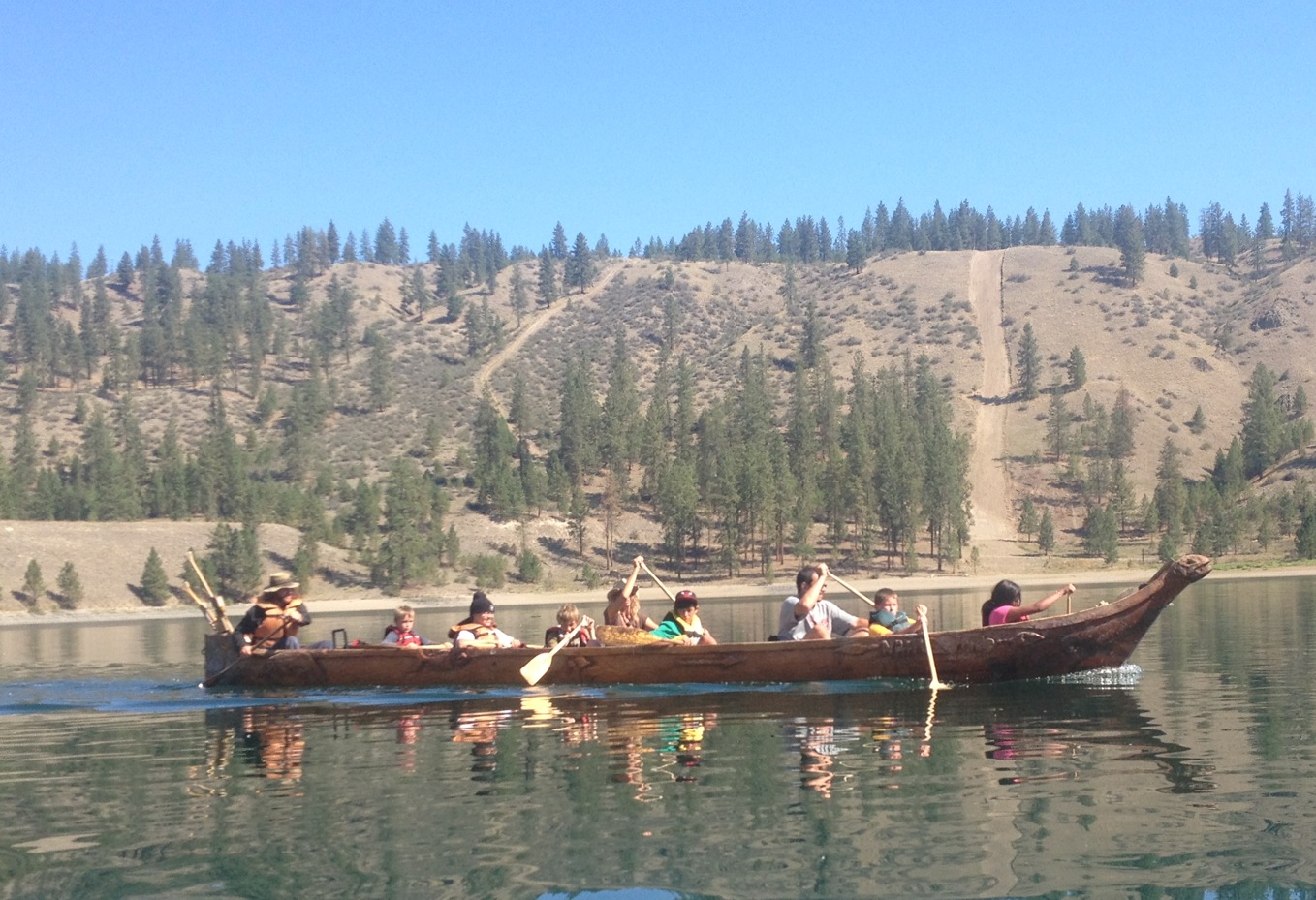
Wellpinit schoolkids paddling their hand-made dugout canoe to Little Falls (Sept. 2013) (photo: Adam Wicks-Arshack)

The two big dugout canoes that paddled from the Pacific Ocean were built by students at Wellpinit, on the Spokane Reservation, and Inchelium, on the Colville Reservation.  Those canoes were returned to their communities in the past few days.  Students paddled the Wellpinit canoe, Salmon Savior, all the way to Little Falls, the original dam that blocked salmon passage into the Spokane River.

Adam Wicks-Arshack displays his trademark enthusiasm for the task of building a new canoe:

Columbia Cedar in Kettle Falls donated enough choice cedar to build the new canoe in the David Thompson style.  The wood comes from a sustainable harvest under the forest stewardship program (no clear cuts).  It is also the most beautiful, clear no-knots cedar we have ever worked with.  So we are excited.  And we invite people up to Kettle Falls Historical Center to help, learn and talk.

Voyages of Rediscovery has put out another short video of their journey from Grand Coulee to Little Falls:   http://vimeo.com/74886255


Leave a comment

Haboob Arrives in Eastern Washington, 9-15-13

Haboob:  An intense dust storm carried across the landscape on an atmospheric gravity current.  Common in arid landscapes such as the Sahara Desert in North Africa, central Australia, and the southwestern United States.

And now, eastern Washington.

Climate change has arrived.


Tri-Cities Dust Storm, Sept. 15, 2013. Photo taken by Bill Cartwright and published on KAPP-KVEW Local News Website.


1 Comment

Columbia Canoe Journey Arrives at Grand Coulee

The “Sea2Source” Columbia River canoeists have arrived at Grand Coulee dam after leaving Astoria, Oregon on August 1st.  Their mission is to paddle to the Columbia headwaters in Canal Flats, B.C.  Along the way, they are educating kids and adults about the salmon that once migrated throughout the entire 1,240-mile river system, and the dams that presently block that migration.

Canoe Journey - Lake Rufus Woods

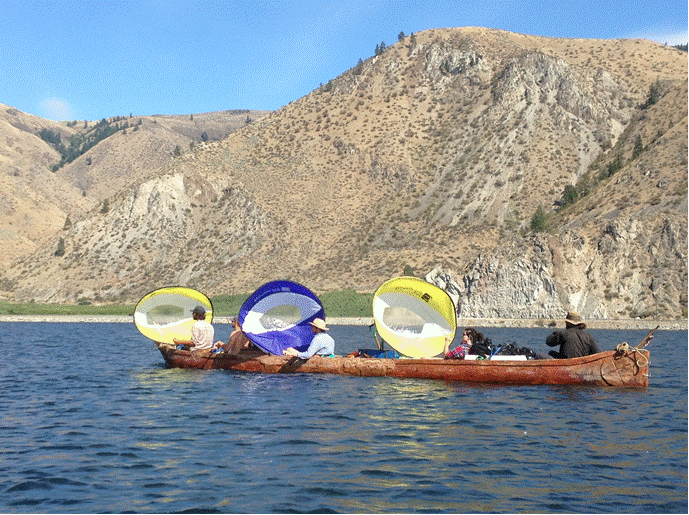
Sea To Source canoe on Lake Rufus Woods, Sept. 2013

Adam Wicks-Arshack and his fellow canoeists invite interested folks to join them to paddle up Lake Roosevelt, departing from Seatons Grove boat launch on Saturday, Sept. 7 at 7:30 a.m. and from Keller Ferry on Sunday, Sept. 8, paddling to Two Rivers.

Next week the Sea2Source canoe journey will travel from the confluence of the Spokane and Columbia Rivers, up the Spokane River to Little Falls — the first dam that blocked salmon from migrating up to Spokane Falls in 1910.   Spokane Tribe schoolkids (who helped build one of the dugout canoes) will join the paddle, and some form of public event will be happening toward the end of the week of September 9th.  Stay tuned – we’ll post as soon as we get the date and location.

You can contact the Sea2Source canoe journey at adamwicksarshack@gmail.com or 917-684-4247.

Follow them on Facebook or the Voyages of Rediscovery website.

The Sea2Source journey needs support.  Your contributions are welcome and can be made here.


Leave a comment

CRT: 18 Conservation Groups Ask for Ecosystem Restoration and Fish Passage

Update August 30:  Eighteen conservation and good government groups sent letters to the U.S. Entity asking that an updated Columbia River Treaty include ecosystem restoration as a third and co-equal purpose (along with hydropower and flood control).  Here are a few salient excerpts, followed by the letters:

Dr. Mindy Smith, Citizens for a Clean Columbia:

It is time to establish true watershed management for this area, in consideration of past damages and climate change, and include the perspectives of those of us who live along the Upper Columbia River. In closing, the CCC board members urge the US entity to continue to make this process transparent and allow public review of supporting deliberative documentation, including technical appendices.

Pat Ford & Joseph Bogaard, Save Our wild Salmon Coalition and Sara Patton, Northwest Energy Coalition:

Save Our wild Salmon’s fishing, fishing business and conservation groups, whose combined members include some 6 million Americans, seek to restore Columbia and Snake Basin salmon for use by people and ecosystems.  NW Energy Coalition, with more than 110 member groups spanning environmental, civic and human-service organizations, progressive utilities and businesses in ID, MT, WA, OR and BC, promotes energy efficiency and renewable energy, consumer and low-income protections, and restoration of fish and wildlife affected by Northwest power production.

The Working Draft recommendation falls short of the changes needed to modernize the Columbia River Treaty so it helps ensure ecosystem health, public health, and economic health for Northwest people for the coming decades.  The 1964 Treaty is insufficient to the challenges of the Basin’s next 50 years, and the Working Draft’s thrust to largely ratify the outdated “two uses only” focus [hydropower and flood control] of the old Treaty, and to emphasize financial over substantive changes, is not in our region’s, or the Columbia Basin’s, interest.

Debrah Marriott, Lower Columbia Estuary Partnership:

Broader dialog with more diverse interests needs to be added to have the discussion and decisions reflect regional values and needs, including conservation, alternative energy, fish passage through upper dams, coordinated storage in Canada, no-structural flood management, the economy, tourism and recreation, strategic levee modification, navigation, commerce, industry, agricultural and cultural impacts.

Click on the group’s name to access its letter.

American Rivers

Aqua Permanenté

Center for Environmental Law & Policy

Citizens for a Clean Columbia

Columbia Institute for Water Policy

Columbia Land Trust

Federation of Western Outdoor Clubs

Idaho Rivers United

League of Women Voters of Idaho

League of Women Voters of Oregon

League of Women Voters of Washington

Lower Columbia Estuary Partnership

Northwest Energy Coalition

Northwest Sportfishing Industry Association

Pacific Rivers Council

Save Our Wild Salmon

Sierra Club

WaterWatch of Oregon


Leave a comment

CRT: 3,200 citizens ask U.S. to restore Columbia River ecosystem

The Columbia River Treaty is in motion.  While U.S. and Canadian diplomats won’t start talking until 2014, U.S. agencies are asking citizens what they want to see in a new treaty.  And the resounding response is: ecosystem restoration, fish passage, clean energy, and fair and transparent governance.

In response to an August 16 deadline, more than 3,200 members of Sierra Club, Save Our Wild Salmon, Oregon WaterWatch, Idaho Rivers United, and the Center for Environmental Law & Policy weighed in.  They  offered their opinions to Bonneville Power and the Corps of Engineers that a modernized treaty must prioritize ecosystem restoration as a new and co-equal purpose for Columbia River dams.  And, it is time to work toward fish passage to restore salmon to the upper Columbia River in the U.S. (e.g., the Spokane River) and British Columbia.

The U.S. agencies will be refining recommendations for a new round of public comment starting around September 19.  Stay tuned and get ready.

However, let us not be deceived.  The electric utilities and water users are demanding more out of the river, including that there be no further efforts or money spent to restore salmon and ecosystem function.  Look for our upcoming post on “Power Politics.”

Meanwhile, here are a few excerpts from the many inspiring comments:

From Judge Mary Pearson:

I’m not a scientist, nor a hydroelectric engineer, but I know that the dams have decimated the salmon and that this has been an ongoing fact.  Some of the dams need to be breached.  Others need to at least install modern, workable, and reliable bypasses for the returning salmon as well as devising a faster, easier, and safer way to get the smolts to the ocean.  If a pneumatic tube can be created to transport man from San Francisco to Los Angeles in a few minutes, it can do the same for the salmon.

From Ms./Mr. Finley:

“No man steps in the same river twice, for it’s not the same river and he’s not the same man,” (Heraclitus, circa 535-475 BC.)

I submit that the Columbia is not the same river it was back in 1964, when global warming and climate change were interesting if debatable theories, fracking was not exactly a household word, and residents of the Pacific Northwest gloried in our land’s cheap electricity, its beauty and seemingly forever adequate natural resources. We are not the same people as we were in the ’60’s. Hopefully new concerns of which we were barely aware in 1964 will be addressed and experience and education will give us wisdom to make protection of the environment our top priority. Thank you for the opportunity to submit a comment.

From Prof. Barbara Cosens of the University of Idaho, on behalf of the Universities Consortium on Columbia River Governance:

 The following comments are based on issues raised by stakeholders either in interviews done by students or in symposia held by the UCCRG. . . .

(2) Although the draft mentions possible attention to a program to reconnect areas of floodplain to the river, this does not go nearly as far as comments by stakeholders suggest it should. Model runs indicate that flood control at 450 cfs primarily through use of a limited list of dams is the major constraint on the system and makes it difficult to balance tradeoffs between power and fish. Stakeholders have raised that serious consideration should be given to raising the target risk level, doing a cost/benefit analysis of potential flood damage to determine what that higher risk should be, spreading flood control implementation to all federal dams in the system – not just those with current flood control authorization, and serious study of non-structural measures for flood risk management.

And, from Kayla L. Godowa-Tufti, member of the Warm Springs Tribe:

Hydropower, to those who have fished and lived along our river since time immemorial, has come at the expense of our entire unique cultural identities. When the dams were constructed our villages, thousand year old fishing sites and burial sites were drowned by the closing of the iron gates.

Currently, as has been reported, many of these dams are now outdated, leaking contaminants into the river and at high risk for breakage. In this critical age of climate change, in the event of a flood, could these dams withstand the pressure from these waters?

I have also been made aware of the current state of the largest environmental clean up project in the world, Hanford, and its leakage of high level radioactive waste into the soil and river. Radioactive waste leakage, floods, along with the out dated dams and their risk of breakage, these accumulative factors could be fatal. I cannot help but think of Fukushima. I do not want my home to be uninhabitable. So, I am challenging our nation, the United States, to honor our treaties and prioritize salmon and river health.

A collective vision is developing for upcoming change on the Columbia River.


Leave a comment

Upcoming Events for the Columbia River

Columbia Watershed Map

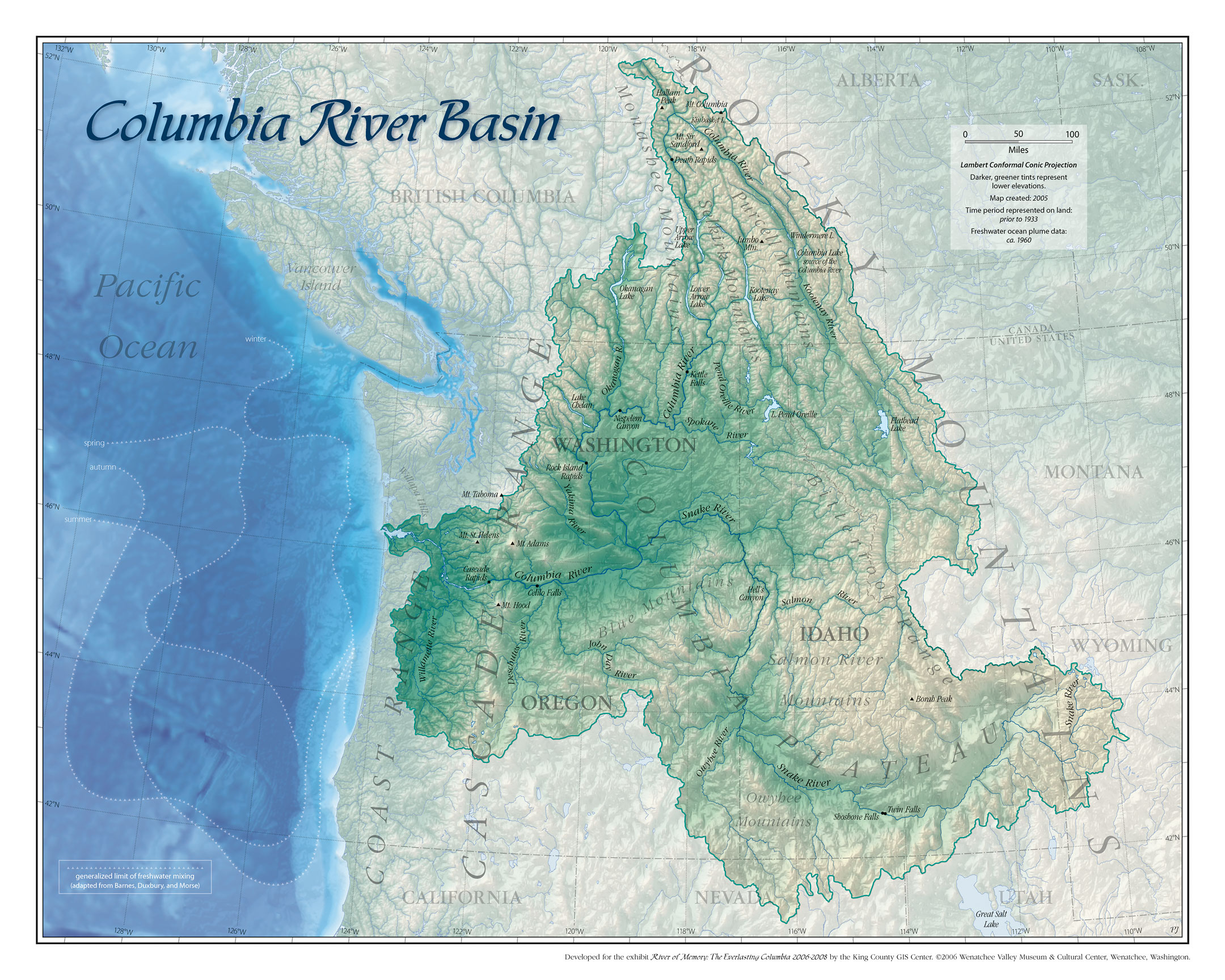
The Columbia Watershed. Map developed by King County GIS for William Layman’s “River of Memory: The Everlasting Columbia, 2006-2008”. Copyright held by Wenatchee Valley Museum & Cultural Center.

Lots of people are meeting and talking about Columbia River watershed issues.  Pick your event!

TODAY, Columbia River, somewhere near Hanford Reach.   The Voyages of Rediscovery crew are paddling two hand-carved dugout canoes up the Columbia River, 1,240 miles from the Pacific Ocean to Canal Flats, B.C.   Their goal is to bring attention to the lack of fish passage into the upper watershed (including in Spokane and British Columbia).  Follow their journey on Facebook.

August 27 and more, on the web.  The River Mile is a wonderful network of educators, students, scientists, resource managers and environmental educators sharing what they know and learn about the Columbia River Watershed.   Teachers – get connected through several upcoming training webinars.

September 20, Seattle.  The Center for Environmental Law & Policy and Futurewise will sponsor a legal education conference, “Hot Environmental Issues for Puget Sound,” including a panel on Spokane River PCB litigation – which has statewide implications for Washington’s fish consumption standards controversy.  Also, upcoming on November 14:  “Blue Meets Green: Growth Management and Water Law.”

September 26, Seattle.  The American Water Resources Association, Washington chapter will hold its annual conference, “Future Directions in Water Resource Management” at the Mountaineers Center.  This blog’s author will present on Columbia Basin issues.

September 28-30, Wandermere, British Columbia.  The Canadian Columbia River Inter-Tribal Fish Commission hosts the 2nd Annual Columbia Salmon Festival at Wandermere and Fairmont, B.C. (in the headwaters) followed by a two-day conference inviting you to “Think Like a Watershed.” The salmon are being called home.

November 19-20, Spokane.  The bi-annual Lake Roosevelt Forum conference will cover multiple topics relating to Columbia River environmental issues.

Spring 2014, Spokane. “Ethics, Water, & the Columbia River Treaty: The Columbia River Pastoral Letter and Creating a Water Ethic in the Northwest,” co-sponsored by Sierra Club and others.  Stay tuned for more info.


Leave a comment

CRT: Ecosystem Function Defined

Columbia Plateau Seasonal Round, from Prof. Eugene Hunn (Em.), Univ. of Washington

Fifteen Native American Tribes inhabit, own reservations, exercise treaty and executive order rights, and manage natural resources in the Columbia River watershed in the United States.  The Tribes understood the opportunities presented by upcoming changes to the Columbia River Treaty.  In response, they adopted a consensus statement of goals and sought and obtained equal participation as part of the U.S. Entity’s Sovereign Review Team, which is tasked with making recommendations to the U.S. Department of State regarding modernizing the Treaty.  Reporter Jack McNeel’s July 25, 2013 Indian Country Today article describes the role of the Tribes in this process.

One of the chief goals of the Tribes is to update the Treaty by adding a third purpose:  ecosystem-based function.  This goal goes far beyond simply operating the Columbia hydropower system to meet Endangered Species Act requirements.  More than a dozen major environmental, clean energy and good government groups endorsed these concepts in comments submitted to the U.S. Entity last week.  See post of August 14 (updated Aug. 18) “Conservation Groups Weigh In.”

With permission, the Columbia River Tribes’ definition of “ecosystem-based function” is re-printed here.  This statement gives insight into just how badly the Columbia River ecosystem is damaged, and what is needed to bring it back to health.  Actions such as improved instream flows, flood plain reconnection and fish passage are essential to achieve river restoration.  (Each of these activities is a big topic in its own right, and will be addressed in detail in future Naiads posts.)

Columbia Basin Tribes’ Definition of Ecosystem-based Function

Since time immemorial, the rivers of the Columbia Basin have been, and continue to be, the life blood of the Columbia Basin tribes.  Columbia Basin Tribes view ecosystem-based function of the Columbia Basin watershed as its ability to provide, protect and nurture cultural resources, traditions, values and landscapes throughout its length and breadth.  Clean and abundant water that is sufficient to sustain healthy populations of fish, wildlife, and plants is vital to holistic ecosystem-based function and life itself.  A restored, resilient and healthy watershed will include ecosystem-based function such as:

  • Increased spring and summer flows resulting in a more natural hydrograph;
  • Higher and more stable headwater reservoir levels;
  • Restoring and maintaining fish passage to historical habitats;
  • Higher river flows during dry years;
  • Lower late summer water temperature;
  • Reconnected floodplains throughout the river including a reconnected lower river estuary ecosystem as well as reduced salt water intrusion during summer and fall;
  • Columbia River plume and near shore ocean enhanced through higher spring and summer flows and lessened duration of hypoxia;
  • An adaptive and flexible suite of river operations responsive to a great variety of changing environmental conditions, such as climate change.

Improved ecosystem-based function in the Columbia Basin Watershed is expected to result in at least:

  • Increased recognition, protection and preservation of tribal first foods and cultural/sacred sites and activities.  First foods includes water, salmon, other fish, wildlife, berries, roots, and other native medicinal plants.
  • An estuary with an enhanced food web and increased juvenile fish survival;
  • Increases in juvenile and adult salmon survival;
  • Decreased mainstem travel time for migrating juvenile salmon;
  • Increased resident fish productivity that provides stable, resilient populations;
  • Increased wildlife productivity that provides stable, resilient populations;
  • Salmon and other juvenile and adult fish passage to historical habitats in the Upper Columbia and Snake River basins, and into other currently blocked parts of the Columbia River Basin.

From Initial Perspectives of the Columbia Basin Tribes for the Recommendations to the Department of State Regarding the Columbia River Treaty Review,” Appendix A, May 29, 2013


2 Comments

Columbia Canoe Journey: Bringing Attention to Fish Barriers on the Columbia River

A remarkable Columbia River journey is underway.  Voyages of Rediscovery, a river-based environmental education program, is paddling two dugout canoes up the Columbia River — making the 1,240-mile journey from the Pacific Ocean at Astoria, Oregon to Canal Flats, British Columbia.   Their mission is to bring public attention to the lack of fish passage at dams on the Columbia River.

The hand-carved canoes were built with the help of young students from the Spokane Indian Reservation and the Colville Reservation.

Today, August 17, the Columbia Canoe Journey is in the Tri-Cities, having traveled 330 river miles from the mouth of the River since August 2.  Here’s a note from Adam Wicks-Arschak, one of the organizers:

We are currently at Tri-Cities.  The trip has thus far been blessed by great tail winds and we have sailed most of the way up river from the ocean where we started on Aug. 2nd.

We paddle in honor of the salmon who can no longer reach their ancestral spawning grounds of the upper Columbia River.  Along the way we have been talking to hundreds of people on the river and sparking conversations about salmon and fish passage issues.  Once schools start up we will be doing presentations and paddling events at the schools.

In particular the schools who carved the canoes will be joining us on portions of the trip.  The Spokane Tribe and Colville Tribe will join us from Chief Joseph (dam) up to their respective communities of Wellpinit and Inchelium.  This will be very powerful, to paddle these salmon-inspired canoes with the youth who carved them, up into the historic spawning grounds of the upper Columbia River.

You can check out a great video about the creation of the two canoes that are making the journey at Voyages for Rediscovery’s website.

Hood River News ran an article about the canoe journey on August 9, as the crew came through the Gorge.

We’ll keep you updated on the journey as it comes up the River.


3 Comments

CRT: Toronto Globe & Mail on Salmon Restoration in British Columbia

Go to the Globe and Mail homepage

http://www.theglobeandmail.com/news/british-columbia/revised-columbia-river-treaty-could-restore-salmon-runs/article13749271/

COLUMBIA RIVER TREATY

British Columbia News

Dream is alive to restore salmon runs; International agreement governing the management of water is up for renegotiation for the first time since it was ratified in 1964

Mark Hume

14 August 2013

©2013 The Globe and Mail Inc. All Rights Reserved.

VANCOUVER — A growing movement on both sides of the Canada-U.S. border wants to make the restoration of salmon runs in southeast British Columbia a key issue in negotiations over the Columbia River Treaty.

If the runs are revived, salmon would once again spawn in the shadows of the Rocky Mountains where they vanished nearly 70 years ago after the Grand Coulee dam was built in Washington State.

“The dream of salmon restoration is alive and well,” said Gerry Nellestijn, who is a member of a citizen group appointed by the B.C. government to provide a “sounding board” for issues related to the Columbia River Treaty.

Mr. Nellestijn said the opportunity to re-establish the runs arises because the treaty, an international agreement governing the management of water in the Columbia River, is up for renegotiation for the first time since it was ratified in 1964.

“A lot of people don’t realize what a big opportunity this is. This is a once-in-a-lifetime chance to restore our salmon runs,” he said.

Salmon were cut off from reaching Canada in the Columbia when the Grand Coulee was completed in 1942.

Canada and the United States began to look at joint management of the Columbia in 1944, but didn’t get around to ratifying a treaty until 1964. Under the deal, B.C. built three dams on the upper Columbia to hold back water that is released to control floods and on demand to maximize power generation south of the U.S. border. B.C. was paid $275-million up front and receives entitlement to half of the hydroelectricity generated in the U.S. by the controlled water releases.

Mr. Nellestijn, who is also the co-ordinator of the Salmo Watershed Streamkeepers Society, said the dams have caused widespread environmental damage in B.C., where river and reservoir levels fluctuate wildly.

“Fish weren’t an issue when they negotiated the treaty,” Mr. Nellestijn said.

He said 40- to 60-pound chinook salmon once spawned in the Salmo River, a tributary of the Columbia in the Kootenays, and other species spawned upstream in tributaries in the Rockies.

“We have lost our coho, chinook, burbot, steelhead and sturgeon. It’s pretty much a disgrace to think about how we allowed this to happen,” he said. “In the treaty they talk about the dollars and cents of the Canadian [power] entitlement, but we are entitled to a healthy environment too.”

John Osborn, a spokesman for the Sierra Club in Spokane, Wash., said the environmental group has written to the two U.S. federal organizations involved in the treaty, urging that “salmon and river health” be made a priority in any negotiations.

Mr. Osborn said restoring salmon runs would require building fish ladders at both the 160-metre high Grand Coulee dam and the 72-metre high Chief Joseph dam, which is located just downstream.

Fisheries experts would also then have to figure out how to reintroduce salmon runs that became locally extinct.

“If we can put a man on the moon we can return salmon to the waters of British Columbia,” said Mr. Osborn of the challenge.

In an e-mail Matt Gordon, a spokesman for the B.C. Ministry of Energy, said the provincial government is currently conducting a review of the Columbia River Treaty, as are the two U.S. agencies involved – the Bonneville Power Administration and the U.S. Army Corps of Engineers.

Mr. Gordon said the B.C. government “will not comment on issues raised by U.S. stakeholders as part of the U.S. process.”

He also said the management of salmon is a federal issue.

A representative of the Department of Fisheries and Oceans was not immediately available for comment.

The Globe and Mail Inc.