Naiads

Water: law/policy/politics/ethics/art/science


Leave a comment

CRT: U.S will withhold key Treaty review analysis from public

On August 6, 2013, the U.S. Entity (Bonneville Power and Corps of Engineers), issued a letter announcing that, in their “continued efforts to provide openness and transparency,” they will not release the technical documents that support their recommendations for re-negotiating or updating the Columbia River Treaty.   The agencies stated that they will not disclose these analytic documents to stakeholders and the public to ensure that upcoming discussions with Canada “not be compromised.”

The U.S. Entity is tasked with preparing recommendations regarding future operations of Columbia River dams with respect to power production, flood control, and as a third new purpose of the Treaty, ecosystem restoration.   The Entity recently issued a set of working draft recommendations that are now circulating for public comment, and is expected to issue the next draft on September 6.

The working draft recommendations are being criticized by both conservation groups and the 15 Native American Tribes that live in the Basin.  Of particular concern is that the working draft over-emphasizes the status quo for hydropower production and flood control, and does not give co-equal status to environmental restoration and functioning of the Columbia River.

Throughout the multi-year process, the U.S. agencies have repeatedly promised that the final round of technical analysis would inform the public about the trade-offs between different uses of the River.  For example, in April 2012 at a Spokane conference, a U.S. Entity spokesman noted that stakeholder comments would be addressed in Iteration 3 of the technical analysis.

Just this month, however, a consortium of 72 Columbia Basin utilities (self-styled the Treaty Power Group) urged the U.S. to “terminate” the Treaty unless an updated Treaty substantially reduces their obligations to share with Canada the surplus energy produced as a result of coordinated operation of Canadian dams (known as the Canadian Entitlement).   With former BPA chief Steve Wright moving to general manager of Chelan PUD, the lead entity of the utilities consortium, and former 18-term U.S. Congressman Norm Dicks serving as their lobbyist, the utilities may be exercising substantial influence over the U.S. Entity’s decision process.

The utility consortium’s position may put the U.S. at serious risk of losing the benefits of coordinated operation of dams, given the British Columbia conclusion in its June 2013 analysis of U.S. benefits from the CRT that “[t]he only benefit to Canada from the Treaty is the sharing of downstream benefits from additional power production potential made possible by the coordination of flows. . . . Simply put, without the Canadian Entitlement, British Columbia would see no reason for the Treaty to continue.”

The technical documents may show that coordinated operations to benefit the Columbia River ecosystem is a viable alternative to the present operational protocols, and could create new incentives for Canada to maintain the Treaty.

1 Comment

Columbia River Treaty: U.S. Seeks Comments on Draft Recommendations

The two U.S. federal agencies tasked with implementing the Columbia River Treaty – Bonneville Power Authority and the Army Corps of Engineers – have also been directed to review the Treaty and make recommendations to the U.S. Department of State regarding potential re-negotiation terms.

The two agencies, which are collectively known as the U.S. Entity, have published a Cover Letter and Working Draft Recommendations and are asking for public comment by August 16.   Based on this first round of comments, a second draft will be published for public review in September.  The U.S. Entity’s goal is to deliver a set of final recommendation to the State Department in December 2013.

While the U.S. Entity has made great strides, the draft recommendations are not strong enough.   The Columbia Institute for Water Policy sent a letter this week explaining the shortcomings.  The U.S. Entity needs to hear the following:

(1) Ecosystem Function.  The United States must unequivocally pursue a new, third, purpose in the next version of the Columbia River Treaty:   Ecosystem Function.   This purpose must be co-equal to the existing purposes of power generation and flood control.   This purpose must embrace restoration of the Columbia River and not simply adopt the status quo of Endangered Species Act compliance.

(2) Fish Passage.  The United States must negotiate with Canada to create a plan to return salmon to the British Columbia portion of the basin.  In other words, fish passage at Grand Coulee and Chief Joseph dams needs to be made a reality.  As a practical matter, Canada will likely be more willing to revisit benefits sharing if it actually gets a benefit.

(3) Green Power.  The old Treaty sends half of the extra power that is generated in the U.S. as a result of the Canadian dams back to British Columbia and its power corporation, B.C. Hydro.  In the future, the calculation of power benefits must include consideration of conservation and renewable energy sources – and thus promote carbon-free energy production.   The existing “Hydropower” purpose of the Treaty must be expanded to “Green Power.”  This is full consistent with the NW Power Council’s Sixth Power Plan, which concluded the Pacific NW can meet the next 20 years’ demand for electricity through conservation and renewable sources.

(4) Updated Flood Management.  The Corps of Engineers manages the Columbia River to reduce flood risk – that’s good.  But the current flood protocols are extremely conservation, and limit creative solutions that would help improve ecosystem function.   The Corps needs to reconsider its flood control operations for the Columbia River.

See the Columbia Institute’s letter for more comments regarding the Working Draft Recommendations.

You can send in your comments to treatyreview@bpa.gov.


Leave a comment

Columbia River Treaty – Bring Back the Fish

Once in a lifetime opportunity.   Sounds like a sales pitch, but it’s true.

The Columbia River Treaty – an agreement between the United States and Canada on how to manage the heavily dammed Columbia River — is up for re-negotiation.

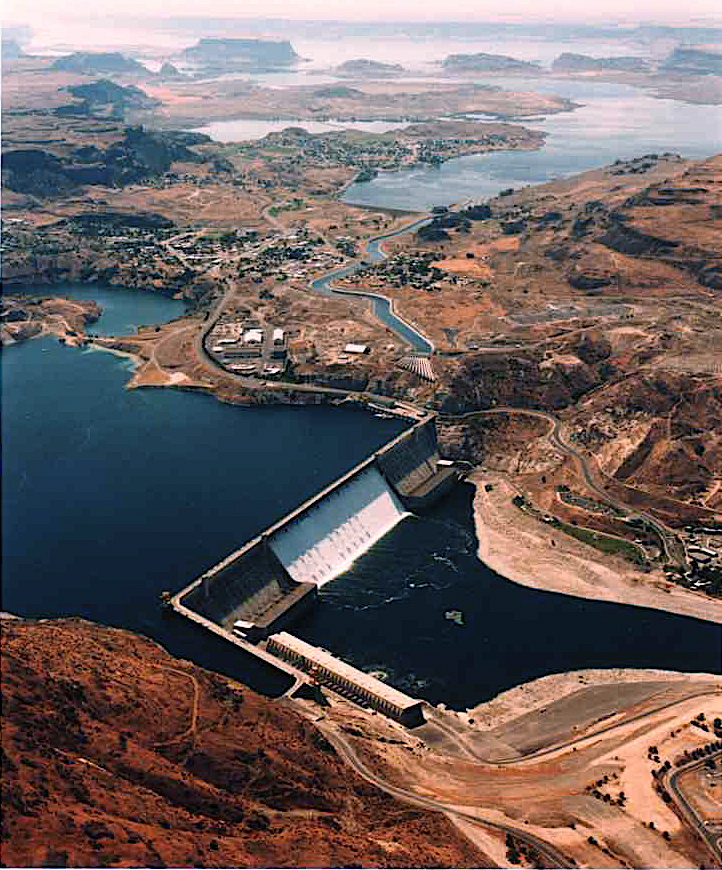
Grand Coulee Dam (photo: U.S. Bureau of Reclamation)

Grand Coulee Dam – lynchpin of the Columbia hydropower system  (photo: U.S. Bureau of Reclamation)

As that re-negotiation gets closer, a window is opening on a whole new way of thinking about the Columbia watershed.   It offers the chance to re-think how floods are managed, how power is generated, and who benefits.

And most importantly, it offers the chance to reimagine the Columbia River as a whole ecosystem.  Can we operate dams in both the U.S. and British Columbia to optimize salmon restoration?   Should we install fish passage at Grand Coulee Dam (and Chief Joseph dam just downstream) to allow the fish to return to the upper Columbia River – in Canada and the U.S.?   (Salmon swam all the way to the headwaters — 1200 miles to the Columbia River Wetlands — until the gates closed at Grand Coulee in 1942.)  Can floods be managed in a more eco-friendly manner?  Should conservation and renewable power be part of the calculation of power benefits in the region?

The answer to these questions is yes.  It is time to bring back the fish, restore the river, honor the treaties with tribes, and thoroughly modernize our approach to managing Nch’i-Wana, the Big River, the Columbia.  That may mean taking a step back in time to allow the river to be a river – rather than trying to engineer our way out of every problem.

The Columbia River Treaty as a document is not hugely complicated.  But the history of the River and how it’s currently managed is quite complex.  As ever, lots of different people and PUDs and cities and irrigation districts want a piece of it.   As the two countries engage in pre-negotiation treaty review, interest groups are emerging.   Pre-positioning is underway – most notably in the U.S. water supply sector.

This blog will endeavor to provide a public interest perspective on Columbia River Treaty happenings across the watershed, in both the U.S. and Canada.  Here you’ll find links to key websites and documents that illuminate what’s going on, along with analysis of what it all means.   Future posts will address the players, the science, the history, the politics, the art and the poetry of the Columbia River.  Stay tuned.

Your comments and information are welcome. 

Go back

Your message has been sent

Warning
Warning
Warning
Warning

Warning.